


Review of: Elan Moritz, Atlantis Revisited – Plato, Myth, and the Making of a Civilization Legend, Eagles Perch Press 21 March 2026. Available only as Kindle book.
Reviewed by: Thorwald C. Franke 23 March 2026.
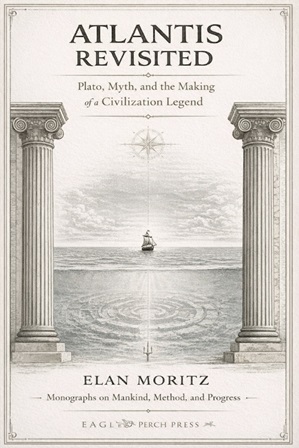
This book looks very promising at first glance. It has a nice cover page and an impressive table of contents. According to the table of contents, valuable questions are asked, and important topics are discussed. This book touches upon almost everything you can only imagine when it comes to Plato's Atlantis. Very interesting! Very exciting!
But at a second glance, a different picture emerges: Each of these chapters is very short, often shorter than one page. The content presented is shallow. The book does not really build up an entirely new argument on its own, but rather compiles what others said, and this not in a very intelligent way. The style is often vague. The author is hyper-cautious in his judgement. No new decisions are made, no new conclusions are drawn. This is one of those books which talks about all and everything around a topic, but in the end you do not know what to think.
The book also repeats all the popular mistakes on Plato's Atlantis as they are still prevailing among Atlantis sceptics: The 9,000 years just taken as a literary invention, without any discussion of a historical-critical interpretation. Aristotle is depicted as a sceptic which he was not, as has been demonstrated by Thorwald C. Franke. In the Middle Ages, no one allegedly talked about Atlantis, according to Vidal-Naquet; but this is not true. Donnelly allegedly was a racist and reconstructed the question of Atlantis. "The Nazis" and Atlantis are not missing, of course not, while socialists abusing Atlantis are not mentioned. And the search for Atlantis is in the end depicted as pseudoscientific nonsense, according to this book. It is not mentioned that academia turned towards the invention hypothesis only in the course of the 19th century, on the basis of very questionable arguments, as Thorwald C. Franke has demonstrated.
The numbers of citations say it all: From the side of the Atlantis sceptics, Christopher Gill is cited ca. 80 times, Pierre Vidal-Naquet is cited ca. 50 times, Stephen P. Kershaw is cited ca. 35 times, Alan Cameron is cited ca. 20 times, Thomas Kjeller Johansen is cited ca. 20 times, Kathryn A. Morgan is cited ca. 18 times. – Whereas from the side of the Atlantis supporters, Stavros P. Papamarinopoulos is cited ca. 20 times, John V. Luce is cited two times, Spyridon Marinatos is cited two times, Thorwald C. Franke is cited once. Not mentioned at all are, e.g., Wilhelm Brandenstein, Massimo Pallottino, Rhys Carpenter, Eberhard Zangger.
The Atlantis Conference by Stavros P. Papamarinopoulos and The Atlantis Research Charter by Thorwald C. Franke et al. are depicted as fake science: "They do not merely exchange ideas; they stage seriousness." – Location hypotheses are distinguished by "text-constrained" and "text-relaxing", i.e., whether they interpret Plato literally or not. Strangely enough, the Minoan hypothesis is put in the "text-constrained" category, although it is certainly not a literalist interpretation of Plato's Atlantis story, but a historical-critical one. The idea of historical criticism of ancient texts is entirely absent from this book. It is just the dumb sticking to the text, or deviating from the text, without asking for good reasons for the one and the other.
The aim of the book seems to be to bring back the idea that Plato's philosophy in the Atlantis story was about political science. Now, this is really nothing new, though it is certainly not wrong. But why then is there no mention of Plato's last dialogue "The Laws"?! With Plato's political philosophy in focus, you just cannot leave "The Laws" unmentioned.
The author also says that he wants to go beyond Plato and Francis Bacon: Inventing better institutions for human society with the help of AI. And doing interstellar travels. He plans a book "New New Atlantis".
In one chapter, the book "The Lost Atlantis" is praised and heavily quoted. Official authors of this book are a certain Kam W. Ng and Chat-GPT-5, i.e., an AI system. But only Kam Ng is mentioned as the author. Yes, this book cites AI content but omits to mention this.
The author Elan Moritz is not known to have built up any deeper knowledge on Plato's Atlantis. When searching for his name, you find several pages of a phycisist of this name (with PhD) who is deeply engaged in Artificial Intelligence and LLMs. On this topic, he has a lot of papers on his pages. On Plato and Atlantis: Nothing.
One year before this book, in 2025, the same author published another strange text: "Isaac Newton and the Alchemical Transformation of English Money: Order, Value, and the Royal Mint". Here, we find the same pattern. A lot of words are made, reporting what is known about Isaac Newton, but in the end nothing really new, nothing which deserves this title. By an author who never before wrote about Isaac Newton and his time, but only about physics and AI.
In February 2026, that is only one month before this book on Atlantis, the same author published a book under the title "The Dollar's Long Goodbye: How Global Money Is Quietly Changing". Quite an achievement to publish on such a variety of topics in such a short time.
This Atlantis book was most probably written with the help from AI. With a lot of help from AI. And it is based more on the popular Atlantis scepticism than on anything else. It is not worth reading. If you want to read a comprehensive text on Plato's Atlantis written by AI, based on Atlantis scepticism, then go to the Atlantis article on Elon Musk's Grokipedia. There, you have it for free.
Besides this, you cannot avoid reading books written by real people. Only then you can build up a real understanding. Slowly and painfully. Over many years. There is no "royal road" to real science. AI may support you to find contents and conclusions more quickly than it was possible in the past, but you still have to read and think on your own. Otherwise you will end up with a lot of popular mistakes, as can be seen in this book, but not with any genuine understanding of what is really going on.
And if I was a proponent of the invention hypothesis, I felt urged to be deeply ashamed of this book. Because, what does it mean that artificial intelligence extracts from the available sources on the invention hypothesis such a low standard text? It simply means that it is the low standard of the academic invention hypothesis itself, which comes to light, here.